Sep 15, 2026
LIZAR Launches Its New Web Platform, with an AI Assistant at the Front Door
Why We Rebuilt the Platform
LIZAR designs, engineers and assembles secure identity systems in Europe, with headquarters in Lisbon, a production facility in Pombal, and regional offices in Bogotá and Praia. Our customers are ministries of interior, national mints, civil registry authorities, security printers, banks and fintechs. These are buyers who read specification sheets before they read marketing copy.
The previous site did not reflect that reality. LIZAR had moved from a single flagship machine to a connected ecosystem of hardware, software and AI modules, and the website still described us as a hardware supplier. Procurement teams could not tell where a laser engraver ended and a fleet management platform began. Technical evaluators had nowhere to check throughput, substrates or compliance standards without emailing sales first.
The brief we gave Caixa Mágica Software was direct. Build a platform that explains a complex product family without diluting it, that works as a reference source during procurement, and that turns anonymous traffic into qualified technical conversations. The result went live in September 2026 in English, Portuguese, Spanish, French and German.
"Before this project, our sales team spent a lot of time manually qualifying every website inquiry. With the assistant Caixa Mágica Software built for us, powered by Claude, we now capture richer, better-qualified leads without any extra effort from our team. It's changed how quickly we can follow up with prospects."
Filipe Castro, CEO, LIZAR Systems
The Starting Point
Identity procurement cycles are slow, technical and heavily documented. A ministry evaluating a card personalization programme will compare throughput per hour, substrate compatibility, security element options, certification status and long-term support commitments before a single meeting is booked. Most of that comparison happens quietly, months before anyone fills in a form.
Three problems shaped the design work.
First, the portfolio had outgrown its own story. DRACO, VARAN and SMAUG cover card personalization, passport and document personalization, and portable power for mobile issuance. Around them sit IGUAN.ai for machine control, IGUAN MDM for fleet management, GUEKO.ai for AI quality assurance, KMODO.ai for chip encoding and digital trust, LOGAU.ai for immutable logging, and ZAR ID for field verification. Presented as a product list, this reads as complexity. Presented as a flow, it reads as an advantage.
Second, technical depth was locked inside sales conversations. Anything a buyer wanted to know required a human on the other end, which slowed early evaluation and filtered out serious prospects who prefer to research before they engage.
Third, the inquiries that did arrive were thin. A name, an email and a sentence tell a sales engineer almost nothing about deployment model, volume, document type or timeline. Every lead started from zero.
Key Features of the New Platform
1. An ecosystem mapped as a flow, not a catalog
The platform's structural decision was to present issuance as an end-to-end chain. A visitor follows the path from a secure data source through machine software, chip encoding, laser engraving, AI inspection and immutable audit logging, ending with verification in the field through ZAR ID. Each stage links to the module that handles it.
This does two things at once. It gives a policy-level reader a single mental model of how a credential is produced and later trusted. It also lets a technical reader jump directly to the component that matters to them without reading anything else. The ecosystem overview page works as a hub, and every module page works as a standalone document.
2. Specification pages written for evaluators
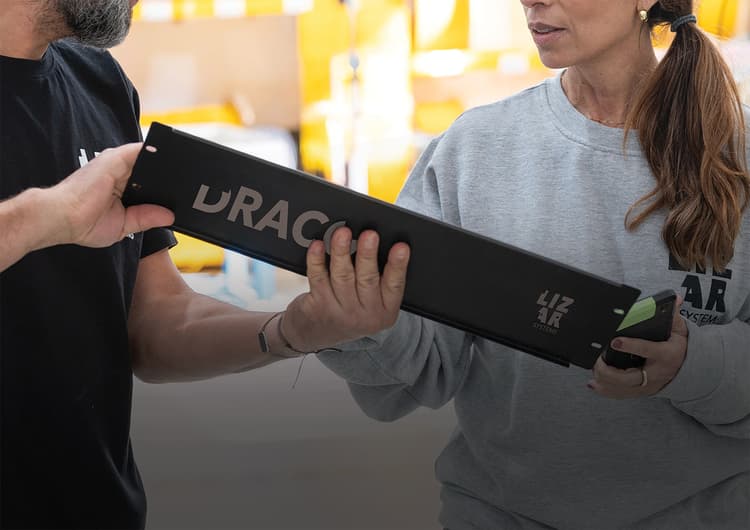
Hardware pages carry the numbers that decide shortlists. The DRACO page states throughput of 40 to 100 cards per hour, under 30 seconds per card for just-in-time issuance, a custom 20 W MOPA fibre laser at 1200 dpi, ID-1 card format, a 200-card input and output feeder, 4G, Wi-Fi and Ethernet connectivity, an authenticated REST API using JWT, and a 30 kg desktop footprint at 304.9 × 472.2 × 483.5 mm.
Compliance is stated with the same directness. The system is a fully enclosed Class 1 laser with integrated filtration, certified to ISO/IEC 27001 and ISO 9001, aligned with ISO 14298 workflows and ICAO 9303 practice. Security elements are split between what is engraved natively, such as CLI/MLI, UV/IR and tactile authentication, and what is available through partners, including OVI, OVD/OVM and SURYS features.
Production evidence sits on the same page rather than in a separate case study section. A fintech deployment of six units with an integrated API personalized more than 100,000 recovery key cards in two months. National identification programmes are running in West and Central Africa, alongside channel deployments named only where partners have authorized it.
3. Solutions organized by operational context
Parallel to the product structure, the platform groups content by deployment context: distributed and mobile issuance, national eID and civil registry, migration and humanitarian operations, critical infrastructure and corporate environments, banking and payments. A consular services director and a card issuing bank arrive with different vocabulary and different constraints. Each finds an entry point that matches the problem rather than the machine.
4. Conversational lead capture with Claude
The assistant replaces the static contact form. It is grounded in the platform's own product documentation, so it answers specification questions accurately instead of improvising. A visitor can ask whether DRACO handles polycarbonate over PVC composite cards, what happens to quality control when a unit runs in a regional office with intermittent connectivity, or how chip encoding fits into an existing PKI. The assistant answers, then moves the conversation toward the parameters a sales engineer needs.
Those parameters are the point. Across a natural exchange the assistant establishes deployment model, expected annual volume, document type, existing infrastructure, geography and timeline. A form asking for the same information in eight fields would be abandoned. A conversation that gives something back with every answer is not.
The implementation includes explicit boundaries. The assistant does not quote prices, does not commit to delivery dates, and does not speculate about certifications the company does not hold. When a question falls outside what the documentation supports, it says so and offers a demonstration request instead. For a company selling into government procurement, that restraint matters more than conversational range.
5. Automated backoffice integration
Every qualified conversation is mapped into a structured JSON payload and pushed to our backoffice over an authenticated webhook. The payload carries the extracted parameters, a summary of the exchange and the full transcript, so the sales engineer who picks it up already knows what was discussed.
Nobody retypes anything. Inquiries arrive classified rather than queued, which means a ministry evaluating a national programme and a student researching laser engraving are separated before a human spends time on either.
6. Five languages, one source of truth
The platform ships in English, Portuguese, Spanish, French and German with a shared content structure, so a specification change propagates to every version rather than drifting. The assistant answers in the language the visitor is using. With teams in Europe, Latin America and Africa, language parity is an operational requirement rather than a nice addition.
7. Performance, structure and accessibility
The build prioritizes fast first loads on constrained connections, since a share of the audience browses from regions where bandwidth is not guaranteed. Heading hierarchy, descriptive alt text and keyboard navigation follow accessibility practice, which also happens to be a procurement requirement in several public sector markets.
Design and Engineering Approach
The visual direction avoids the two failure modes common in this sector. Identity technology sites tend to drift either into stock imagery of glowing padlocks or into dense engineering documentation with no narrative. LIZAR needed the middle ground: serious enough for a ministry, readable enough for a first visit.
The interface leans on product photography of the actual machines, a restrained typographic system and generous spacing around technical tables. Specification data is presented as data, in a consistent format across every hardware page, so a reader comparing DRACO and VARAN scans the same rows in the same order. Diagrams carry the ecosystem flow rather than paragraphs describing it.
On the engineering side, the content model was built so that product specifications live in one place and render wherever they appear. When throughput or certification status changes, it changes once. For a company shipping hardware revisions and adding software modules, that constraint protects the accuracy of the site over time, which in a procurement context is not a cosmetic concern. A published figure that no longer matches the machine is a problem long before anyone notices it.
Results
The clearest change is in what arrives. Qualified inquiries are up significantly since launch, and the qualification work now happens before a human is involved rather than after. Our sales engineers open a lead with deployment model, volume and timeline already recorded.
Response time improved as a consequence. A conversation that ends at two in the morning in Bogotá is already structured in the backoffice when the Lisbon team starts work. Follow-up begins with a relevant answer rather than a request for basic information.
There is a second benefit that is easy to miss. Conversation logs show what prospects actually ask, which questions recur, and where the documentation is thin. That feedback now shapes the content roadmap directly.
Three patterns came out of the first weeks. Buyers ask about deployment flexibility far earlier than expected, often before they ask about throughput, which suggests distributed issuance is the differentiator that lands first. Questions about AI quality control cluster around auditability rather than accuracy, since a public authority needs to explain a rejection, not just record it. And a consistent share of traffic arrives looking for passport personalization rather than cards, which has shifted how prominently VARAN is positioned.
None of that would have surfaced through a contact form. A form collects intent; a conversation collects reasoning.
What Comes Next
The next phase extends the assistant into partner onboarding, where the qualification logic applies to a different audience with different criteria. Work is also planned on deeper technical documentation for integrators, including API reference material for teams building on the REST interface.
Frequently Asked Questions
What is the new LIZAR web platform?
It is the official LIZAR Systems platform, covering our secure identity issuance ecosystem: DRACO card personalization, VARAN document personalization, SMAUG portable power, and the IGUAN, GUEKO, KMODO and LOGAU software modules. It includes an AI assistant built on the Claude API.
Which languages is the platform available in?
English, Portuguese, Spanish, French and German, with a shared content model so specifications stay identical across every version.
How does the AI assistant qualify leads?
It answers technical questions using the platform's own product documentation, then establishes deployment model, volume, document type, geography and timeline through conversation. The result is mapped into a structured payload and sent to the LIZAR backoffice.
Does the assistant replace the sales team?
No. It handles first contact and preliminary qualification, then hands over a documented conversation. Pricing, commercial terms and technical scoping stay with our engineers.
Which technologies run the platform?
A custom build integrated with the Anthropic Claude API for the conversational layer, connected to the LIZAR backoffice through authenticated webhooks.
How do I request a demonstration?
Use the demo request form or start a conversation with the assistant, which will capture your document type, volume and deployment context before passing it to an engineer.
Share this resource